


48 Hours in Buenos Aires – Welcome To The City of Fury

The first time I came to Argentina’s capital, I hit the city like a freight train and felt like it hit me right back…it’s not a city that does things in half-measures.
It’s a city that rewards attention, which is obviously a downside of a flying visit.

48hrs in Buenos Aires before you head south to hike Patagonia (more on that here), Tierra del Fuego (yep, I’ve covered that too) or to the wine country around Mendoza (on the bucket list) is enough time to both give you a flavour of the city and to tick off a whole new country.
This itinerary leans into contrast rather than completeness, you’ll never achieve that in 48hrs. Day one moves through neighbourhoods that define the city’s identity - immigrant docks, aristocratic avenues, and bookish sanctuaries…and yes, the inevitable steak and Malbec dinner. Day two steps briefly outside Argentina altogether, crossing the Río de la Plata to a town that feels suspended somewhere in the 19thcentury, before returning for tango that is social rather than staged.
Stay at Bulnes Eco Suites, a well-located and clean hotel in Palermo, walking distance to La Cabrera and the nightlife with comfy beds and great staff. Very close to cafes on Av. Santa Fe and access to local services
Intrigued? Good, let’s get to it.
At A Glance
What To Do
Half-Day Private Guide – Covering many of the attractions listed here, if you’re super tight on time or just don’t feel like doing things yourselves, this private tour is superb.
San Telmo Food Tour – Feeling peckish? This crash course in Argentine delicacies will give you everything you need to skip dinner. Don’t pair this with your booking at La Cabrera.
Head to Uruguay – You don’t need a fancy tour to add another country to your itinerary, just book your boat a few days in advance. Fares start at around $50 return.
Good to Know
Ubers are cheap and plentiful and frankly the easiest way to get around. The subway is clean and even cheaper but I got tired quickly visiting multiple kiosks and shops that trying to buy tickets only to be told ‘no hay’. In the itinerary below, unless otherwise stated, assume I’m using Uber to get between places.
Most, but not all, places accept card so it’s worth carrying cash with you. Thankfully, the new 20,000 Peso note has started to become much more widespread so you won’t be walking round with a wallet bulging with the a hundred bills each worth $1. ATMs rarely dispense more than $100 in one go (and charge hefty fees) so it’s worth bringing USD to exchange at FX places.
Day 1, Morning: La Boca and San Telmo
Begin in La Boca, where the city first expanded beyond its colonial core and the most popular tourist area. You’ll inevitably be drawn here the first time you visit so come early before the crowds descend and it becomes a crowded caricature.

Caminito’s brightly painted houses were originally built from scrap wood and sheet metal by dockworkers, their colours dictated by leftover ship paint. Today it is theatrical, but the theatricality reflects genuine history. Walk the strip once, then step away from it into the side streets where laundry hangs above doorways and football murals replace souvenir stalls. You’ll get more selfies with Lionel Messi more times than you care to remember.
From La Boca, continue north into San Telmo, one of the few areas where the original street grid of the city survives. On Sundays, the San Telmo Market (open daily 09.00 – 18.00) spills across Plaza Dorrego, mixing antiques, vinyl records, mate gourds, and improvised tango performances – people watching here is top tier. On weekdays, the indoor market still hums with local lunch counters and produce stalls rather than tourists. Well worth picking up some assorted snacks for lunch.
Late morning is ideal for Café Tortoni (open daily 08.00 – 21.00). Founded in 1858 and the oldest café in the city, it hosted writers, politicians, and tango musicians for decades. Order simply, coffee and a medialuna (the ubiquitous Buenos Aires pastry), and enjoy the people watching. Your feet will thank you for the break.
Day 1, Afternoon: Recoleta Cemetery, Japanese Garden & El Ateneo

The mood shifts north in Recoleta Cemetery (open daily 09.00 – 17.00), where Buenos Aires’ elite built their afterlives in stone.
Although it’s popular with tour groups, step away from the most popular routes (anything Evita related) and you quickly become lost in a maze of mausoleums stacked like apartments, some immaculate, others visibly abandoned as family fortunes faded.
Eva Perón’s tomb is the main event that draws crowds, but the surrounding graves, industrialists, military figures, philanthropists, tell a broader story of power and decline – 100 years ago Buenos Aires was one of the richest five cities on Earth. Go figure.
No less contemplative but with a completely different vibe, take a gentle stroll (30 minutes) or a 10 minute Uber to the Japanese Garden (open daily 10.00 – 18.45), one of the largest of its kind outside Japan. Entry is paid, but the koi ponds, sculpted bridges, and deliberate quiet after the intensity of Recoleta. The on-site café is particularly welcome to escape the early afternoon heat.
In the park outside the garden, keep an eye out for the remarkable paseadores de perros, the dog walkers who can quite happily exercise a dozen of the city's pooches at once.
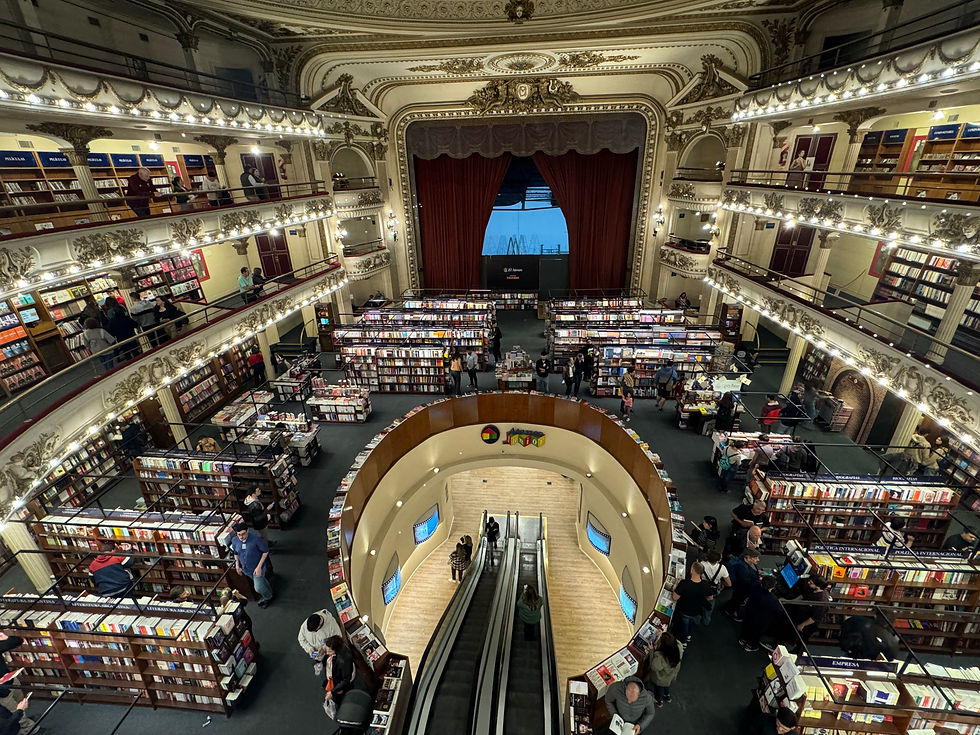
Heading back into the city, I implore all book lovers to pay a visit to El Ateneo Grand Splendid (open daily 09.00 – 21.00, Sunday from 12.00), a former opera house turned bookshop – apparently the largest in South America.
Sit in the former stage café and look up…the ceiling fresco remains intact. It is exceptionally photogenic and it reflects Argentina’s long-standing reverence for literature and public culture. Also a very good spot to pick up volumes on your future Argentine destinations
Day 1, Evening: La Cabrera & Palermo Drinks
A friend insisted that our trip to Buenos Aires would not be complete without a visit to La Cabrera, widely regarded as one of the city’s best steakhouses.
We struck out on our first night but the very helpful staff pointed out that if we booked the following night before 7pm, we’d receive 50% off our food bill.

Granted, this means you will be eating with other tourists but goodness me, the food is worth it. Steaks arrive with a procession of small sides - pickled vegetables, mashed pumpkin, chimichurri – and the accompanying malbec is exceptional. Portions are generous; if you’re even thinking of dessert, arrive hungry! If you're feeling flush and want to eat later, you can book a table here.
Afterwards, stay nearby.
Palermo’s nightlife can be chaotic, but the best bars are focused rather than flashy. Florería Atlántico (closes 1.30am) is hidden behind a functioning florist, with a basement space dedicated to Argentine spirits and regional ingredients with a world travel theme. It is intimate, professional, and reliably excellent.
If that feels too polished, Verne Club (closes 2am, 3am Friday & Saturday) offers a quieter alternative, specialising in Argentine gin and whisky. Locals arrive late; visitors tend to leave early. Stay long enough and the balance shifts.
Day 2 – Welcome to Uruguay
Who doesn’t love getting an unexpected new country on their travels? Particularly one with as cool a flag as Uruguay.

Day two begins at Puerto Madero, where ferries depart across the Río de la Plata to Colonia del Sacramento in Uruguay. Multiple operators ply the route – we chose Colonia Express which was clean, efficient and easy to book online. Book tickets several days in advance and bring your passport; check-in about an hour before departure. The crossing takes roughly 75 minutes.
Colonia feels intentionally slower. No scratch that, it feels like another world. Founded by the Portuguese in 1680, its Barrio Histórico reflects centuries of disputed ownership. Cobblestone streets slope gently toward the river, houses sit low and irregular, and traffic is minimal…a sense that is heightened after the sprawl of Buenos Aires. It’s about a fifteen-minute amble from the ferry port to the Barrio.

Walk the old city walls, climb the lighthouse for views back toward Buenos Aires and grab a leisurely lunch along the riverfront. These simple parrillas or cafés serve grilled meat, salads, and surprisingly Moorish Uruguayan wine.
The pleasure here lies in unstructured time - wandering, sitting, watching ferries come and go. Unlike some other border crossing towns (looking at you Ciudad del Este!) this one is actually a pleasure to spend an afternoon in. 3-4 hours should be sufficient when booking your ferry.
A mid-late afternoon return allows you to re-enter Buenos Aires without fatigue, refreshed rather than rushed.
NB: Uruguay has its own currency, the peso, it’s easy enough to change money in the ferry terminal.
While some businesses will accept Argentine pesos or US dollars, others (like the lighthouse) do not so it’s worth changing enough for lunch, souvenirs and entry fees.
Day 2, Evening: It Takes Two To Tango

Your final night belongs to tango but not the contrived, dinner-and-a-show variety. Choose a milonga where tango resembles the social language it originated as rather than a performance for gawping tourists. La Catedral Club (closes 2am, closed Sunday - Monday) is a favourite: cavernous, mismatched, and welcoming, with live music on certain nights and dancers of all levels sharing the floor.
Alternatively, Milonga Parakultural (opening times vary) offers a similarly informal experience, often attracting an intergenerational local crowd – decidedly untouristy. Arrive late - tango begins properly after 10:00pm - and spend time watching before joining in.
This is tango as lived culture and a fitting way to close two days in a city that prefers participation over slick presentation.
48 hours in Buenos Aires – The Lowdown
This city does not announce itself; it unfolds before your very eyes. Over 48 hours in Buenos Aires, the city reveals its character through an accumulation of experiences. It may be fraying around the edges but dive into its neighbourhoods and you’ll experience the Argentina you imagined – loud, warm and with a strong sense of identiy and pride. And then when you’re done, hop over to Uruguay, it would be rude not to!


Argentina's culture, passion, and energy are truly unmatched — from the tango-lit streets of Buenos Aires to the vast Patagonian wilderness. With world-class executive courses in Buenos Aires, Argentina drawing global talent, the country is evolving fast. The real question isn't if you should go — it's why you haven't yet.